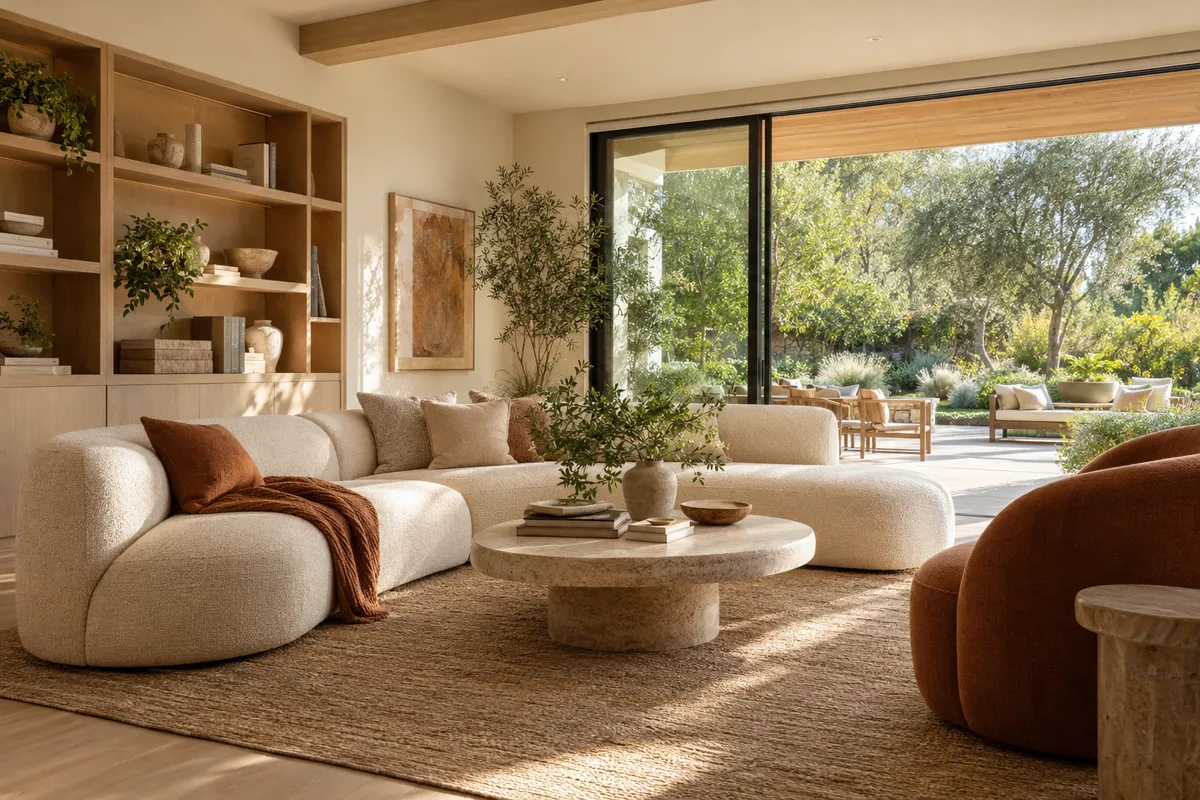
A Mandeville Canyon living room by the firm Marmol Radziner just earned a spot in Modern Luxury's Design 9 Awards for Southern California's best living room. Per Modern Luxury, the design makes room for softer silhouettes and a whole lot of family time.
That is a high-end house, and your budget probably looks different. But the idea underneath it travels well: a living room can look polished and still be a place where people actually sprawl out. Here's how to borrow that thinking, whatever your square footage.
A quick note on what we know. Modern Luxury's write-up, as summarized, tells us the room leans on softer shapes and is built around family time. We don't have a product list or floor plan, so the tips below are our own takeaways from that direction, not a description of what's in the room.
Start with the question: who actually uses this room?
The most useful part of the project's framing is the priority order. Family time comes first, and the polish follows. Before you buy anything, spend a few days noticing how your living room gets used.
- Where does everyone land when they sit down?
- Where do shoes, blankets, and laptops end up?
- What do you avoid doing in the room because it feels too nice?
That last question is the big one. If a piece makes you say "don't sit there," it is working against the room.
Swap one hard edge for a soft one
Softer silhouettes simply means rounded, curved, and gentle shapes instead of sharp corners and rigid lines. You don't need a full redo to try it. Pick one or two swaps:
- Coffee table: A round or oval table is easier to walk around and kinder to knees and small kids. Secondhand shops and marketplace listings are good hunting grounds.
- Ottoman: A round upholstered ottoman can double as a seat, a footrest, and a surface with a tray on top.
- Mirror or art: An arched or circular mirror softens a wall of straight lines for very little money.
- Lamp shades: A drum or rounded shade changes the feel of a corner for the price of a new shade.
You're aiming for a few curves that break up the boxiness, not a room made of circles.
Make the layout do the family work
Soft furniture means little if the layout keeps people apart. A few practical moves:
- Face seating toward each other. If everything points at the TV, conversation dies. Angle a chair or two inward.
- Leave clear paths. Aim for a walkway you can cross without turning sideways.
- Give every seat a landing spot. A small side table or stool within reach of each seat keeps cups off the floor.
- Create a floor zone. An open rug area gives kids, pets, and game nights somewhere to happen.
In a small apartment, this might mean one loveseat, two floor cushions, and a rug. In a bigger home, it might mean a second conversation cluster. The principle is the same.
Choose fabrics you won't panic over
Relaxed elegance depends on materials that can take real life. We can't say what Marmol Radziner used here, so treat this as general advice. When shopping on a budget:
- Look for tightly woven or textured fabrics, which tend to hide wear better than smooth ones.
- Pick removable, washable slipcovers when you can.
- Use throw pillows and blankets for the soft, layered feel, since they're cheap to replace.
- Test fabric swatches with a damp cloth before committing.
Keep the palette calm
A quiet, warm palette helps a room feel put-together without effort. Stick to two or three main tones and let texture do the rest: a nubby throw, a woven basket, a wood side table. This is also the cheapest way to make a mixed bag of furniture look intentional.
Let polish come from restraint
The high-end look often comes from editing rather than adding. Try clearing every surface, then returning only what earns its place: one lamp, one stack of books, one plant. Give storage a home, such as a lidded basket for toys or a console with doors, so the room resets in five minutes.
The takeaway
This week, do one small thing: sit in every seat in your living room and ask whether you'd happily stay there for an hour. Fix the first one that fails, ideally with a curve, a cushion, or a better layout, and let the room get a little more livable from there.