
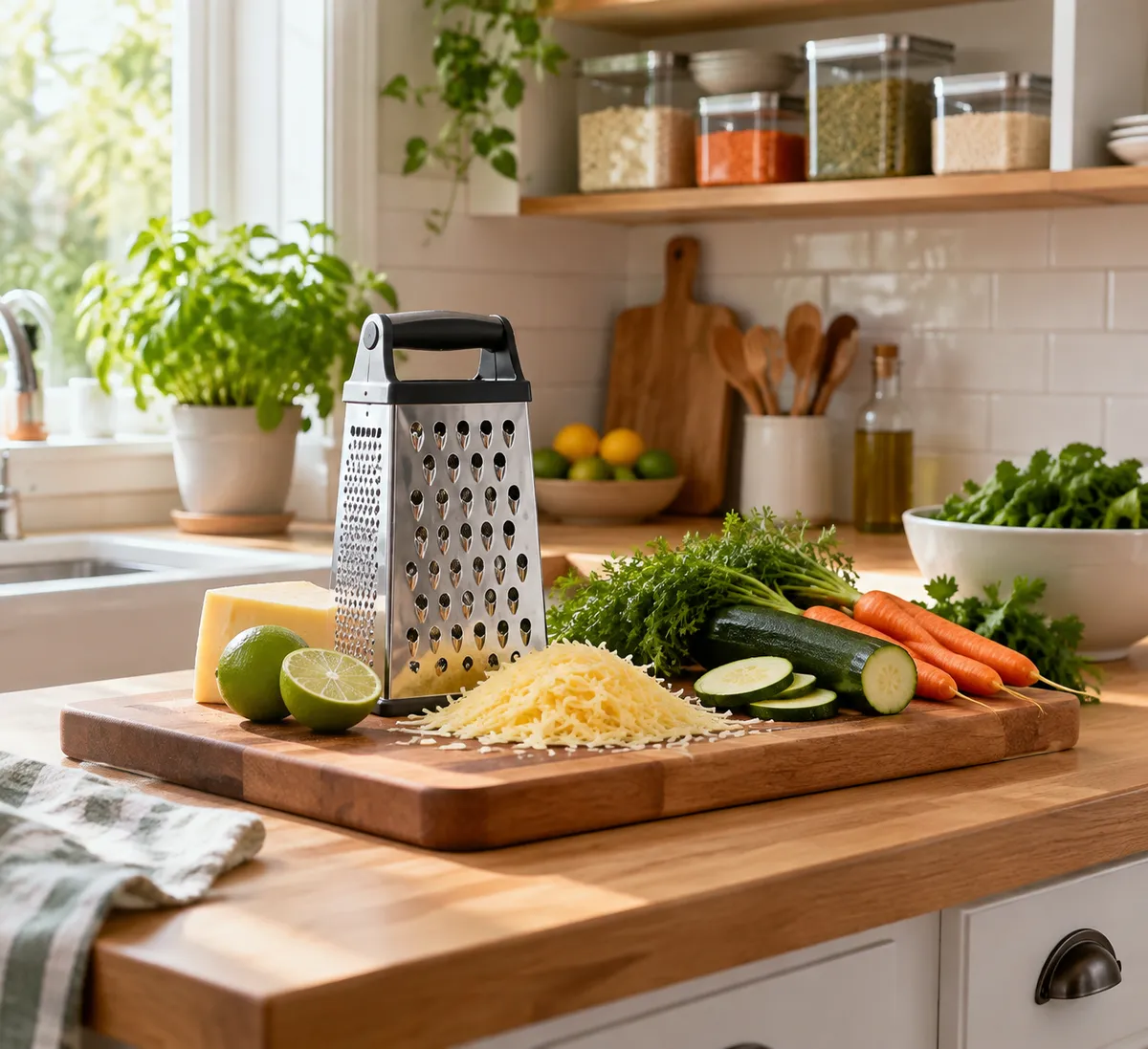
BuzzFeed recently published a roundup of 56 kitchen products it calls worth both the space and the money. The full product list isn't something we can reproduce here, so we won't pretend to. What we can do is hand you the thinking behind a list like that: a way to decide for yourself whether any gadget earns a spot in your kitchen.
By the end, you'll have a four-question test you can run on any pricey pan, appliance, or tool before you click "buy," plus a few ways to apply it in a small kitchen.
Why the "space and money" framing matters
Most gadget regret comes from paying twice. You pay once at checkout, then again every day the thing takes up a cabinet, a drawer, or a patch of counter you'd rather use.
BuzzFeed's pitch is that the products on its list justify both costs, and it notes that both come at a premium. That's the right way to look at it. A $30 tool that lives on your counter and gets used twice a year is more expensive than a $60 one you grab every night.
The four-question test
Run any candidate through these before buying.
1. How often will you actually use it?
Be honest about your real cooking, not the version of you who makes fresh pasta every Sunday. If you can't name three meals you'd make with it this month, pause.
2. Does it do more than one job?
Multi-use items reduce clutter. A good heavy pan that goes from stovetop to oven, or a knife that handles most prep, replaces several single-purpose tools. If the pitch is one narrow trick, the item has to be truly great at it to earn space.
3. Will it outlast the cheaper version?
Durability is where a higher price can make sense. Look for simple construction, replaceable parts, and materials you can wash and maintain easily. Fewer moving parts usually means fewer things that break.
4. Where will it live?
Pick the exact spot before you buy. If the answer is "somewhere," it will end up on the counter or buried in the back of a cabinet. If it needs a dedicated shelf, ask whether it's worth the trade.
Do the cost-per-use math
This is the easiest way to see whether a premium price makes sense. Divide the price by the number of times you expect to use it.
- A $80 pan used three times a week for two years is around 312 uses. That's roughly 26 cents a use.
- A $25 gadget used four times total is over $6 a use.
Those numbers are illustrations, not claims about any specific product, but the pattern holds. Things you use constantly get cheaper the longer you own them. Things you use rarely never do.
Where spending more usually pays off
These are general rules of thumb, not endorsements of particular items.
- Things you touch every day. Your main knife, your go-to pan, your cutting board. Small improvements in comfort and performance add up over hundreds of uses.
- Things that replace disposables. Reusable containers or tools that stop you from buying a recurring supply can pay back over time.
- Things that solve a specific annoyance. If you cook often and a certain task frustrates you every time, a better tool for that job is worth considering.
Where to save instead
- Single-use novelty tools. If it only does one thing and you can do that thing with a knife or a fork, skip it.
- Items that duplicate what you own. A second gadget for the same job rarely earns its place.
- Anything you're buying for an aspirational hobby. Borrow, rent, or try it first. Wait a few weeks and see if you still want it.
Making it work in a small kitchen
Small spaces make the space-cost side of the equation louder.
- Set a one-in, one-out rule. If a new item arrives, something leaves.
- Favor nesting and stacking. Items that fit inside each other or hang on a wall rail take less room.
- Keep the counter for daily-use items only. If you don't use it most days, it goes in a cabinet.
- Try before you commit. Use a friend's version, or wait for a sale on something you've had your eye on. Waiting costs nothing.
A budget-friendly way to use roundups like BuzzFeed's
Treat a list of 56 as a menu, not a shopping cart. Skim it, pick the two or three items that solve problems you really have, and run those through the four questions above. If they pass, buy one. Live with it for a month. Then decide whether the next one earns its spot.
That's the whole trick: buy for the kitchen you actually cook in, and make every item justify its square inches before it gets any of your cash.